Yes — cancer survivors can eat fat without gaining weight. The key isn't avoiding fat or counting calories. It's understanding that hormones, specifically insulin and leptin, decide whether the food you eat gets burned or stored. When you choose the right fats and eat them the right way, they can actually help you lose weight, reduce inflammation, and rebuild your energy after treatment.
Let me walk you through the science behind this — and one simple change that makes it work.
Why Does Food Feel So Stressful After Cancer?
After cancer, your relationship with food shifts. Every bite suddenly carries weight — not just physically, but emotionally. You start second-guessing meals you never thought twice about. And fat, being the most calorie-dense nutrient, becomes the first thing people want to cut.
I hear this all the time in my clinic: "Is it really safe for me to eat foods rich in fat without harming my health?"
The short answer is yes. But the reason might surprise you — because it has almost nothing to do with calories.
Calories Don't Decide What Happens in Your Body — Hormones Do
This is the piece that's almost always missing from the conversation around weight.
Calories are just units of energy. They tell you how much energy is in the food. They don't tell you what your body does with that energy. That part is controlled by your hormonal environment — specifically, by insulin.
Here's a striking example: when a person with type-1 diabetes forgets to inject insulin after a meal, glucose shows up in their urine. The calories were consumed, but without insulin to guide them into cells, the body literally excretes them. Same calories. Completely different outcome.
So the question isn't how many calories are you eating? The real question is: what are your hormones doing with them?
The Two Hormones That Control Your Weight
Insulin: The Traffic Controller
Insulin doesn't just manage blood sugar. It directs all incoming energy — from carbs, proteins, and fats — telling your body whether to burn it or store it.
When insulin levels are chronically elevated (a state called insulin resistance), the signal is clear: store everything as fat. This is the metabolic environment where weight loss becomes nearly impossible, no matter how little you eat.
Leptin: The Missing Signal
Insulin has a partner — leptin. Under healthy conditions, leptin tells your brain: "We have plenty of energy. It's safe to burn fuel freely."
But when insulin resistance sets in, leptin signaling breaks down too. This is called leptin resistance. Your brain stops hearing the message, even when your fat stores are full. Without that signal, your body shifts into energy-conservation mode: metabolism slows, movement decreases unconsciously, and fat cells lock down.
This can mean burning hundreds fewer calories per day — without feeling any different or doing anything differently.
A 2024 study published in the Journal of Clinical Endocrinology and Metabolism looked at 1,290 healthy adults across different body weights and found that those with elevated leptin relative to their fat mass also had insulin resistance — regardless of whether they were overweight. You don't need to be heavy for this to happen.
Why Two People Can Eat the Same Meal and Get Different Results
Picture two women, same age, same weight, sitting across from each other at a restaurant. They order the same slice of cake — 500 calories each.
One gains weight from it. The other doesn't.
It's not willpower. It's not genetics alone. Their bodies are processing those calories differently because their hormones are working differently. When insulin and leptin are balanced, your body burns fuel efficiently. When they're not, even "eating very little" may not trigger fat loss.
Why Fat Is Actually the Least Stressful Nutrient for Your Hormones
Among carbs, proteins, and fats, dietary fat triggers the smallest insulin response. That means two meals with the same calorie count can produce completely different hormonal outcomes.
A meal rich in healthy fats and low in refined carbohydrates keeps insulin low, allows fat burning to continue, and supports steady energy throughout the day. A meal with the same calories but loaded with processed carbs spikes insulin and shifts the body into storage mode.
This is the distinction that changes everything.
So What Actually Causes Weight Gain When Eating Fat?
Two things.
First: combining the wrong fats with insulin-spiking carbs. Most meals that "contain fat" also contain refined carbohydrates — bread, pastries, sugary sauces. That combination is the real recipe for weight gain: high insulin plus high calories. The fat itself isn't the problem. It's what it's paired with.
Second (and this is the one most people miss): constant snacking. Every time you eat — even something small — insulin rises. A piece of fruit here, a handful of crackers there. It doesn't feel like much. But hormonally, it means insulin never fully comes back down. And when insulin stays elevated, fat burning stays off. Leptin can't do its job. The body stays stuck.
This matters especially for cancer survivors. The WHO ranks excessive weight gain alongside smoking in terms of cancer risk. And many survivors experience lasting changes in insulin sensitivity and inflammation after treatment. Managing weight isn't about vanity — it's about reducing one of the most significant modifiable risk factors for recurrence.
Which Fats Help — and Which Ones Hurt?
Not all fats are equal. The ones that support recovery share three traits: they're stable, anti-inflammatory, and minimally disruptive to insulin.
Fats to prioritize:
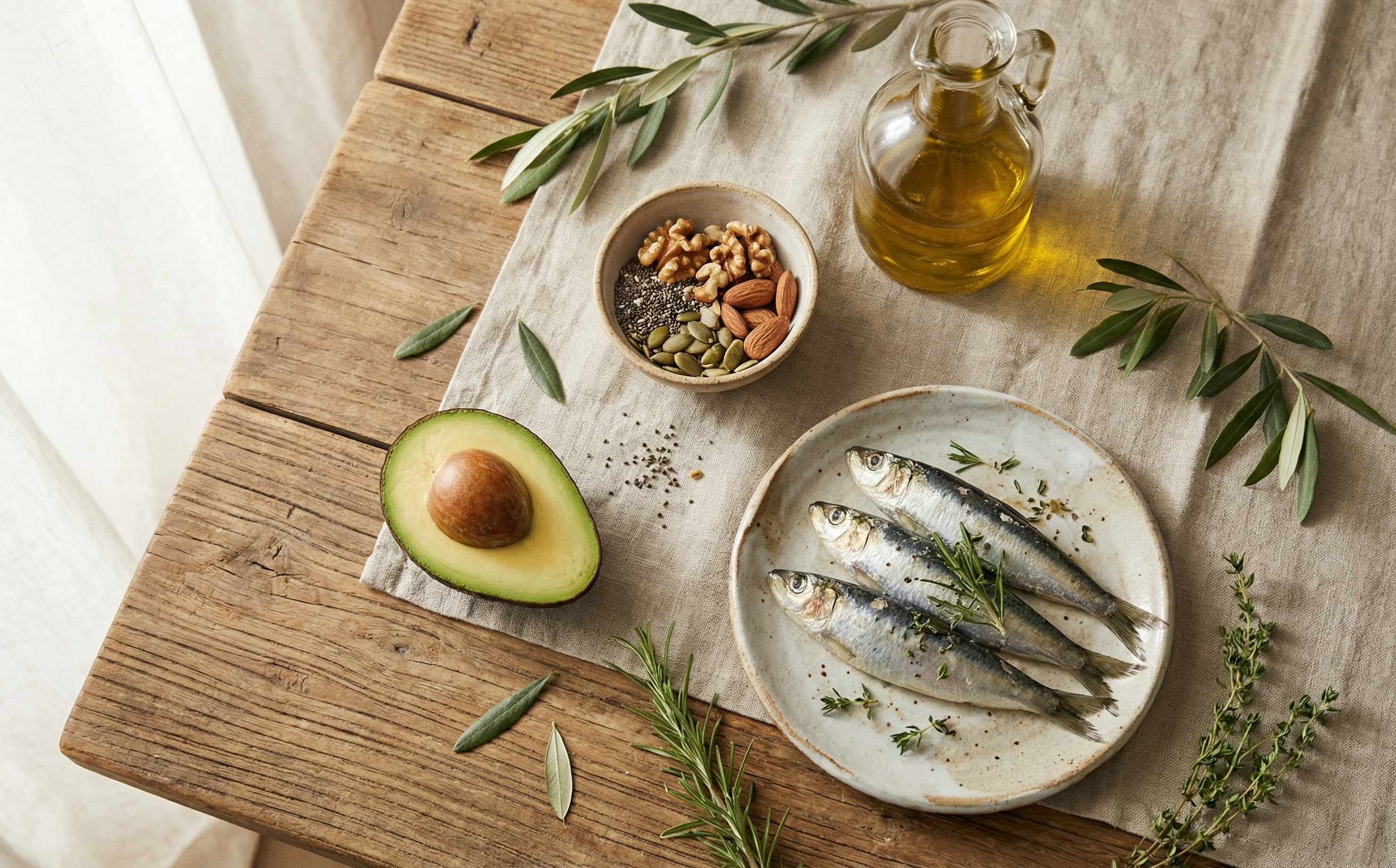
- Nuts and seeds (almonds, walnuts, flax, chia, hemp)
- Avocado
- Extra virgin olive oil (unrefined)
- Omega-3-rich fish low in the food chain: sardines, anchovies, herring, salmon
Fats to minimize:
- Refined vegetable oils (canola, soybean, sunflower, corn oil)
During refining, these oils are stripped of the antioxidant shield that naturally protects them inside the seed or nut. Once inside your body, these unprotected fats are vulnerable to oxidative damage — and when they oxidize, they themselves become a source of chronic inflammation, damaging blood vessels and cells from the inside.
A note on animal fats
Fats from meat, poultry, dairy, and seafood can accumulate environmental toxins called dioxins. These are classified as carcinogenic. The higher an animal sits in the food chain, the more dioxins accumulate — a process that doesn't happen in plants. A good rule: get most of your fats from plant sources. When eating fish for omega-3s, choose smaller species lower in the food chain.
One Simple Change That Rebalances Your Hormones
You don't need to count calories. You don't need to overhaul your entire diet.
Choose one meal each day that's built around healthy fats paired with high-fiber vegetables — green leaves, non-starchy veggies, and a portion of protein. That's it.
The fats provide deep, lasting satiety. The vegetables add volume and fiber with minimal caloric load. Together, they naturally crowd out the foods that stress insulin — bread, pastries, sweetened yogurts, sugary snacks.
I've watched this happen over and over in my clinic. Cancer survivors who'd been stuck with extra weight for years, who'd tried every low-calorie approach and failed — they start building meals around good fats and vegetables, and the weight finally starts to move.
Why does it work? Because it addresses the root issue. Instead of fighting against your biology by restricting calories, you're working with it by restoring the hormonal signals that let your body release stored energy on its own.
The Two Mistakes to Avoid When Adding More Fat
Mistake #1: Eating heavy meals close to bedtime. Late heavy meals disrupt sleep quality, and poor sleep is one of the fastest paths to elevated insulin. Protect your sleep by keeping evening meals lighter and earlier.
Mistake #2: Grazing between meals. Three solid, satisfying meals — no snacking in between. You don't need to eat less food. You need to give your body clear on/off signals. When meals are spaced and insulin has time to fall between them, fat cells can finally release energy, leptin starts working again, and weight becomes dramatically easier to manage.
The Bottom Line
Fat is not the enemy. The wrong fats combined with insulin-spiking carbs and constant snacking — that's the pattern that causes weight gain. When you choose stable, anti-inflammatory fats, pair them with fiber-rich vegetables, and give your body clean breaks between meals, your hormones can do what they're designed to do.
Food stops being stressful. Your body starts working with you again.
Although I'm a registered dietitian, I'm not your dietitian. This article is for educational purposes only. Always consult your healthcare team before making changes to your diet, especially after cancer.